Statement for the 2026 Spring Meetings of the IMF-World Bank
The April 2026 Spring Meetings of the International Monetary Fund and the World Bank Group (IMF-World Bank) are being held in a time of the United States’ (US) strategic decline and intensifying rivalry against other world powers. IBON International views this week’s meetings as reflective of the US’ current goals: to slow down its decline, and reinforce an untenable economic system.
Under Trump, the current chief representative of finance capital in power, the US in recent years escalated unilateral measures and imperialist aggression in line with “America First.” Brazen offensives struck Palestine, Venezuela, and Iran explicitly for US security and economic interests. The financial oligarchy with large shareholdings in arms and oil companies, meanwhile, rejoice in their rising capital market gains amid war and oil shocks. Even so, the world economy is far from returning to even pre-pandemic growth rates, and its volatilities become increasingly exposed. The US government’s illegal and unjust wars have isolated it even from some of its close allies.
In this context, US finance capital and corporations require an expanded search for resources and low-waged labour. US-dominated international financial institutions (IFIs) support such a quest for more extraction. The current US national security strategy states that “[the Trump] administration is dedicated to using its leadership position [in IFIs] to implement reforms that ensure they serve American interests.”
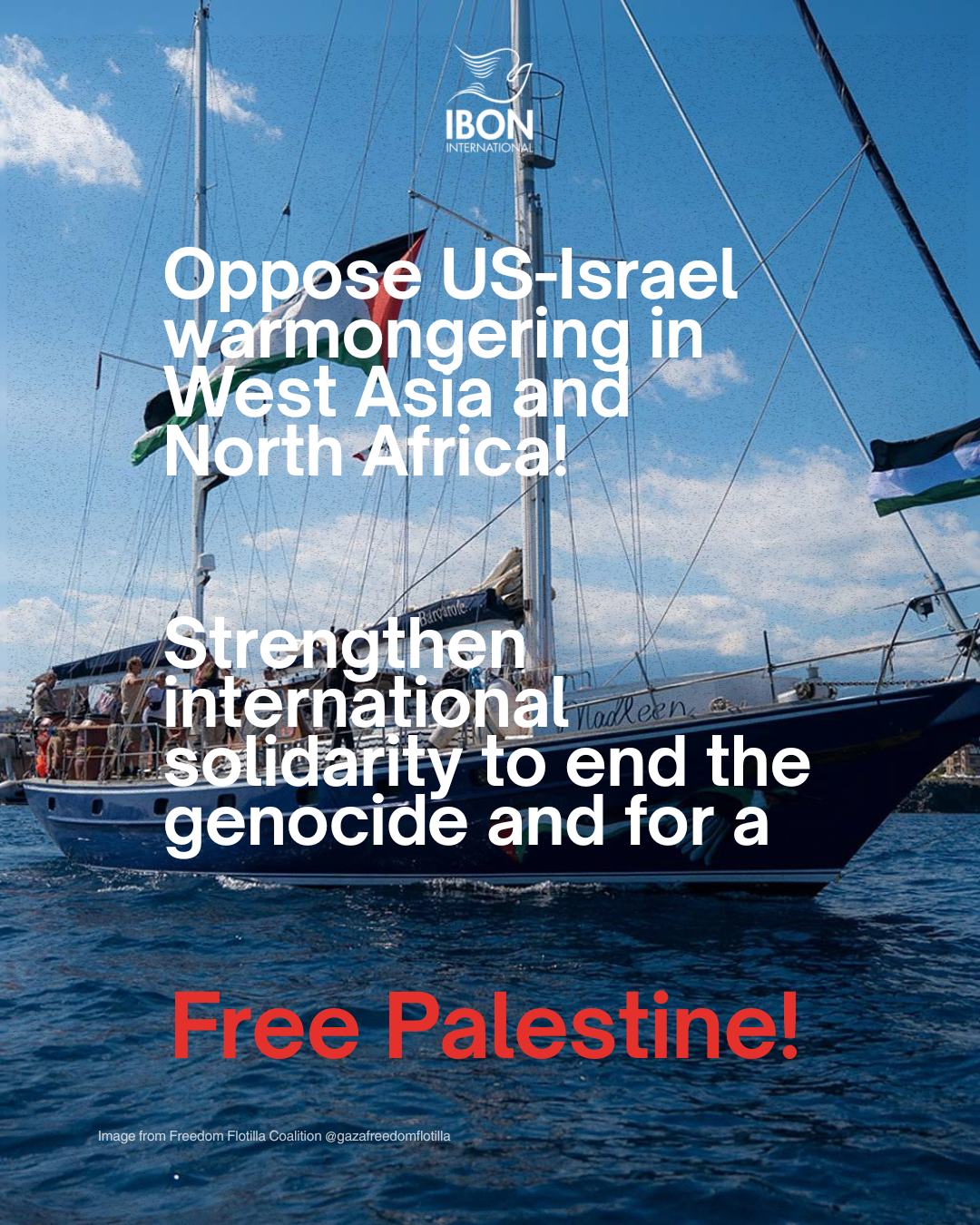
The World Bank’s involvement in the so-called Board of Peace clearly supports US foreign policy objectives. After arming the Israeli occupation for decades, the US now leads the BoP to oversee Gaza “reconstruction” under terms favourable to itself and Israel. So-called reconstruction becomes further annexation and erasure. To consolidate the occupation’s hold, the BoP’s approach is premised on the disarmament of armed groups resisting Israel.
Critics such as UN experts have condemned the BoP as illegal and illegitimate; yet the Bank has supported it from the beginning. The Bank created and has been managing a Gaza Reconstruction and Development (GRAD) financial intermediary fund. The GRAD fund envisions reconstruction as a private sector-led effort, with Gaza as a new “market” for investors. With UN estimates showing USD 70 billion is required for Gaza reconstruction, the Bank’s approach auctions the annexation of Gaza to corporate actors already complicit in the economy of genocide.
The same assumptions favourable for big business drives the World Bank’s “jobs agenda,” a central item in the 2026 Spring Meetings. The World Bank narrative advocates for even more “better business climates”, based on the claim that this will generate jobs especially in infrastructure and energy, agribusiness, healthcare, tourism, manufacturing. These claims are belied by historical evidence that the IMF-World Bank’s track record of oppressive structural adjustment created decades of low-waged and precarious jobs, eroded labour rights, and drove unemployment. In a time of slow growth, the “jobs agenda” facilitates increased corporate access to low-waged labour to increase super-profits.
The insistence on private capital as the primary driver for development has been disproven time and again by the experience of global South countries, where large foreign corporations hollowed out domestic manufacturing and agriculture and shaped export-oriented economies. The World Bank has recently admitted that they may have been mistaken in imposing more than four decades of neoliberal structuring. Instead, the Bank has recently “re-introduced” industrial policy as a viable tool for countries. But the Bank’s approach is far from envisioning industrial policy in terms of broader structural change. It continues to promote industrial parks and special economic zones – often sites of labour rights violations—as these can tap “specialized or low-cost labor.” The Bank’s narrative is a smokescreen when much damage has been done.
Decades of IMF-led austerity continue to extract super-profits from debt, by passing the burden onto the shoulders of working people. The IMF has been imposing or normalising austerity policies throughout the decades, ranging from public spending cuts to attracting more revenue through reliance on private investors. Pakistan and Sri Lanka in Asia, Zambia and Kenya in Africa, and Argentina in Latin America are just a few that saw movements opposing IMF bailouts, increasing debt, and austerity in the last few years.
For more than 80 years, the IMF and the World Bank have undermined people’s rights and sovereignty. With the US as the most powerful shareholder, these institutions came to Asia, Africa, and Latin America to integrate these regions into the monopoly capitalist world economy. The IMF-World Bank shaped the role of the state to centre on enabling better business climates and de-risking investments. The neoliberal offensive did so to stave off the economic crisis of its time. Along the way it eroded public services, decimated previously-won working people’s rights, and barred sovereign development strategies.
Decades ago, the IMF-WB functioned to repel the US’ primary opponent, socialist influence, during the Cold War. Infrastructure projects, loans, and country programmes, supported US-allied governments and propped up elite dictatorships. Afterwards, the IMF-World Bank consolidated US influence across the world through the “Washington Consensus”.
These eight decades of the IMF-WB’s existence runs parallel with decades of peoples’ resistance: from opposing harmful projects, loans and imperialist debt, to criticising policies and repackaged neoliberal impositions throughout the decades.
The longstanding call to shut down the IMF-World Bank remains relevant. Doing away with their past and present policy impositions can open up opportunities in global South countries to advance sovereign economic change, construct their own models, and reorient priorities for domestic needs instead of external markets. Calling to shut down the Bank, given its complicity in the violating Palestinian self-determination, becomes one element in fighting militarism and genocide today. Lastly, calling for the shut down of the IMF and World Bank is a call for accountability and reparations — as a guarantee of non-repetition of harm, by ending one source of economic and social rights violations inflicted on working people around the world. #
![[Website cover] DevCoop meeting](https://iboninternational.org/wp-content/uploads/2026/02/Website-cover-DevCoop-meeting-1.png)